
ISO 27001 Certification in Sweden
ISO 27001 Certification in Sweden is the independent, third-party confirmation that an organization’s Information Security Management System (ISMS) conforms to the requirements of ISO/IEC 27001:2022 — the internationally recognized standard for information security governance. Certification is issued only after a structured conformity assessment conducted by a qualified, independent audit body. CertPro, a Licensed CPA Firm, conducts ISO 27001 certification audits for organizations across Sweden, evaluating ISMS design, implementation, and operational effectiveness against the full requirements of the standard.
OUR CLIENTS

What Is ISO 27001 Certification and Why Does It Matter for Organizations in Sweden?
ISO 27001 Certification in Sweden is the independent, third-party confirmation that an organization’s Information Security Management System (ISMS) conforms to the requirements of ISO/IEC 27001:2022 — the internationally recognized standard for information security governance. Certification is issued only after a structured conformity assessment conducted by a qualified, independent audit body. CertPro, a Licensed CPA Firm, conducts ISO 27001 certification audits for organizations across Sweden, evaluating ISMS design, implementation, and operational effectiveness against the full requirements of the standard.
For organizations operating in Sweden — including SaaS providers, fintech firms, healthcare institutions, cloud service providers, AI companies, gaming businesses, telecommunications providers, and enterprises handling sensitive data — ISO 27001 Certification in Sweden demonstrates structured, audited information security governance to customers, regulators, procurement bodies, and international partners. Sweden’s technology sector, anchored in Stockholm, Gothenburg, Malmö, and Uppsala, operates within a complex regulatory environment shaped by the EU General Data Protection Regulation (GDPR), the Swedish Data Protection Act (Dataskyddslagen), the NIS2 Directive, and the Digital Operational Resilience Act (DORA).
While ISO 27001 certification does not automatically establish compliance with these laws, it provides a structured, evidence-based framework that organizations can reference when demonstrating information security governance to regulators, customers, and business partners.
ISO/IEC 27001:2022 is the current version of the standard, published in October 2022. Organizations previously certified to the 2013 version must transition to the 2022 standard by October 31, 2025, as established by accredited certification bodies. The 2022 revision reduced the number of Annex A controls from 114 to 93, reorganized across four domains: Organizational Controls, People Controls, Physical Controls, and Technological Controls.
It also introduced 11 new controls addressing threat intelligence, cloud service security, data masking, and ICT readiness for business continuity — reflecting the evolving information security landscape facing Swedish and European organizations.
ISMS certification under ISO 27001 signals to the market that an organization has subjected its information security controls to independent scrutiny. For Swedish technology companies competing for enterprise contracts across the EU, the United States, and international markets, ISO 27001 Certification is frequently a mandatory procurement requirement.
Public sector entities in Sweden, financial institutions regulated under DORA, and healthcare organizations subject to GDPR processing obligations increasingly require ISO 27001 certification from vendors and suppliers as part of third-party risk management programs. The certification provides an independently verified basis for assessing information security governance — a function that internal self-assessments and security questionnaires cannot replicate.
CertPro evaluates organizations against the full clause structure of ISO/IEC 27001:2022, including Clauses 4 through 10 — covering context of the organization, leadership, planning, support, operation, performance evaluation, and improvement — as well as the applicable controls selected in the organization’s Statement of Applicability. The ISO 27001 certification audit is conducted across two structured stages, followed by ongoing surveillance audits and a three-year recertification cycle.
Organizations that achieve ISO 27001 Certification in Sweden receive a certificate valid for three years, subject to satisfactory annual surveillance audits demonstrating continued conformance and continual improvement of the ISMS.

ENQUIRE NOW
Related Resources
Related Services in Sweden
ISO 27001 ISMS Framework
The ISO/IEC 27001:2022 standard provides a structured framework for establishing, implementing, maintaining, and continually improving an Information Security Management System. The ISMS framework is built on a Plan-Do-Check-Act (PDCA) cycle that requires organizations to systematically identify information security risks, implement controls to address those risks, monitor and measure control effectiveness, and drive continual improvement.
ISO 27001 compliance requires that the ISMS be proportionate to the organization’s risk environment, business context, and the nature of the information it processes, stores, and transmits. This scalability makes ISMS certification achievable for organizations of all sizes operating across Sweden’s diverse industries.
Core Clauses of ISO/IEC 27001:2022
ISO/IEC 27001:2022 is structured around ten clauses. Clauses 1 through 3 define scope, normative references, and terms. Clauses 4 through 10 contain the mandatory requirements assessed during an ISO 27001 certification audit. Key clause requirements include:
- Clause 4: Define the internal and external context relevant to the ISMS, identify interested parties, and establish the ISMS scope.
- Clause 5: Mandate leadership commitment, establish an information security policy, and assign roles and responsibilities.
- Clause 6: Address planning — requiring a risk assessment methodology, risk treatment plan, and documented information security objectives.
Each clause must be fully addressed and evidenced for an organization to achieve ISMS certification under ISO 27001.
Clauses 7 through 10 govern operational requirements and performance evaluation. Clause 7 covers support requirements including competence, awareness, communication, and documented information. Clause 8 addresses operational planning and control, including execution of the risk assessment and treatment processes. Clause 9 requires performance evaluation through monitoring, measurement, internal audit, and management review — all of which must be evidenced during an ISO 27001 audit.
Clause 10 mandates that organizations address nonconformities and pursue continual improvement of the ISMS. During the ISO 27001 certification audit, auditors assess documented evidence of conformance across all mandatory clauses before a certification decision is reached.
Annex A Controls and Statement of Applicability
Annex A of ISO/IEC 27001:2022 contains 93 information security controls organized across four domains: Organizational Controls (37 controls), People Controls (8 controls), Physical Controls (14 controls), and Technological Controls (34 controls). Organizations are not required to implement all 93 controls. Instead, they must select controls applicable to their identified risks and document their selection in a Statement of Applicability (SoA).
The SoA must list all Annex A controls, indicate whether each is applicable or excluded, provide justification for exclusions, and reference the implementation status of each control. The SoA is a mandatory document reviewed during every ISO 27001 certification audit and must remain current throughout the certification lifecycle.
The 11 new controls introduced in the 2022 revision address modern information security challenges directly relevant to Swedish technology organizations. New controls include Threat Intelligence (5.7), Information Security for Use of Cloud Services (5.23), ICT Readiness for Business Continuity (5.30), Physical Security Monitoring (7.4), Configuration Management (8.9), Information Deletion (8.10), Data Masking (8.11), Data Leakage Prevention (8.12), Monitoring Activities (8.16), Web Filtering (8.23), and Secure Coding (8.28).
For SaaS companies, cloud service providers, AI firms, and fintech organizations operating in Sweden, these controls address critical areas where information security risks are concentrated. During the ISO 27001 audit, auditors verify that selected controls are implemented and operating effectively as described in the SoA.
| Annex A Domain | Number of Controls | Examples of Controls |
|---|---|---|
| Organizational Controls | 37 | Threat intelligence, cloud service security, supplier relationships, information security policies |
| People Controls | 8 | Screening, terms of employment, information security awareness, disciplinary process |
| Physical Controls | 14 | Physical security perimeter, clear desk policy, equipment maintenance, secure disposal |
| Technological Controls | 34 | Access control, cryptography, data masking, secure coding, web filtering, monitoring |
Risk Assessment and Risk Treatment
ISO 27001 compliance requires organizations to establish and apply a documented risk assessment process that identifies information security risks, analyzes their likelihood and impact, and evaluates them against defined risk acceptance criteria. The risk assessment must be repeatable, producing consistent and comparable results across assessment cycles.
Organizations must identify risks associated with the loss of confidentiality, integrity, and availability of information within the ISMS scope. Risk owners must be assigned for each identified risk. The risk assessment process must be conducted at planned intervals and whenever significant changes occur — a requirement auditors verify through documented risk assessment records and management review outputs during the ISO 27001 certification audit.
ISO 27001 Certification Requirements
Achieving ISO 27001 Certification in Sweden requires an organization to demonstrate conformance with the full mandatory requirements of ISO/IEC 27001:2022, including all applicable clauses and the controls selected in the Statement of Applicability. The ISO 27001 certification audit evaluates whether the ISMS has been properly established, implemented, maintained, and continually improved — and whether the controls in place are operating effectively to manage information security risks within the defined scope.
ISO/IEC 27001:2022 specifies mandatory documented information that must be maintained and retained as evidence of ISMS conformance. Required documents include:
- ISMS scope and information security policy
- Risk assessment methodology, results, and risk treatment plan
- Statement of Applicability (SoA)
- Information security objectives
- Evidence of competence and awareness
- Results of monitoring, measurement, and internal audit
- Management review outputs and records of nonconformities and corrective actions
During the ISO 27001 certification audit, auditors systematically review these documents to confirm that required documented information is present, current, controlled, and consistent with actual ISMS operation. Missing or inconsistent documentation typically results in nonconformity findings that must be resolved before certification can be issued.
Beyond documentation, ISO 27001 compliance requires organizations to demonstrate that controls selected in the Statement of Applicability are operationally implemented and functioning as intended. Commonly assessed technical areas include access control mechanisms, cryptographic key management, network security architecture, vulnerability management, incident detection and response capabilities, backup and recovery procedures, and supplier security management.
For Swedish organizations operating cloud infrastructure, SaaS platforms, or data processing environments, technical controls addressing cloud service security (Annex A 5.23), ICT readiness for business continuity (5.30), and data leakage prevention (8.12) receive particular scrutiny during the ISO 27001 audit.
- ✓Defined and documented ISMS scope covering relevant organizational boundaries and information assets
- ✓Documented information security policy approved by top management and communicated to relevant personnel
- ✓Completed risk assessment with identified owners, likelihood and impact ratings, and risk treatment decisions
- ✓Statement of Applicability listing all 93 Annex A controls with applicability decisions and implementation status
- ✓Implemented risk treatment plan with controls mapped to identified risks
- ✓Evidence of internal ISMS audit conducted by competent, independent auditors within the certification period
- ✓Documented management review covering ISMS performance, risk landscape, and continual improvement decisions
- ✓Records of nonconformities identified and corrective actions taken to address root causes
ISO/IEC 27001:2022 places significant emphasis on top management commitment and accountability. Clause 5 requires that top management demonstrate leadership by establishing an information security policy, aligning ISMS objectives with organizational strategy, assigning information security roles and responsibilities, and actively participating in management review.
During the ISO 27001 certification audit, auditors interview senior leaders to verify that management engagement is genuine and evidenced — not merely nominal. Organizations where ISMS governance is siloed within an IT department without executive engagement frequently encounter major nonconformity findings related to Clause 5 requirements. These findings must be resolved through documented corrective actions before certification can be issued.
- ✓Documentation Requirements
- ✓Technical and Operational Requirements
- ✓Leadership and Organizational Requirements
ISO 27001 Certification Audit Process in Sweden
The ISO 27001 certification audit process follows a structured, multi-stage methodology that evaluates ISMS design adequacy and operational effectiveness. CertPro conducts ISO 27001 certification audits for Sweden-based organizations across all stages — from initial scope definition through certification decision and ongoing surveillance. Each stage is conducted by qualified auditors with relevant information security competence, applying consistent evaluation criteria derived from ISO/IEC 27001:2022 and ISO 19011 audit methodology principles.
The Stage 1 audit is a documentation and readiness review conducted before the full on-site or remote assessment. During Stage 1, auditors evaluate the organization’s ISMS documentation against the requirements of ISO/IEC 27001:2022. Auditors review the ISMS scope, information security policy, risk assessment methodology and results, Statement of Applicability, risk treatment plan, and key ISMS procedures.
The Stage 1 audit determines whether the ISMS is sufficiently developed and documented to proceed to the Stage 2 audit. Auditors identify any areas where documentation is absent, inadequate, or inconsistent — producing a Stage 1 findings report that informs the Stage 2 audit plan. Organizations typically have an opportunity to address Stage 1 findings before the Stage 2 ISO 27001 certification audit commences.
The Stage 2 audit is the primary ISO 27001 certification audit, assessing whether the ISMS is implemented and operating effectively in practice. Auditors conduct interviews with personnel across relevant functions, observe processes and technical environments, and test controls against documented procedures and risk treatment decisions.
The Stage 2 audit covers all applicable clauses of ISO/IEC 27001:2022 and the controls listed in the Statement of Applicability. Auditors assess objective evidence — including logs, records, configuration outputs, access control lists, and incident records — to determine whether controls are operating as described. Nonconformities identified during Stage 2 are classified as major or minor. Major nonconformities require corrective action and verification before the certification decision can be finalized.
ISO 27001 Certification is valid for three years from the date of issue, subject to satisfactory annual surveillance audits. Surveillance audits are conducted at least once per calendar year during the three-year certification cycle to verify that the ISMS continues to conform to ISO/IEC 27001:2022 requirements and that the organization is driving continual improvement.
Surveillance audits typically focus on internal audit results, management review outcomes, corrective actions, changes to the ISMS scope, and selected Annex A control areas. At the end of the three-year cycle, a full recertification audit reassesses the ISMS against all requirements of the standard. Organizations that fail to maintain conformance during surveillance may have their ISO 27001 certification suspended or withdrawn.
| Audit Stage | Purpose | Typical Duration |
|---|---|---|
| Stage 1 Audit | ISMS documentation and design review; readiness determination for ISO 27001 certification | 1–2 days |
| Stage 2 Audit | Operational effectiveness assessment; control testing and evidence review | 2–5 days |
| Surveillance Audit (Year 1) | Continued conformance verification; targeted control and process review | 1–2 days |
| Surveillance Audit (Year 2) | Continued conformance verification; ISMS performance and improvement review | 1–2 days |
| Recertification Audit | Full re-assessment of ISMS against ISO/IEC 27001:2022 requirements | 2–4 days |
- ✓Stage 1 Audit — ISMS Design Review
- ✓Stage 2 Audit — Operational Effectiveness Assessment
- ✓Surveillance Audits and Recertification
ISO 27001 Certification in Sweden — Local Context
ISO 27001 Certification in Sweden is pursued by organizations across a broad range of industries, driven by procurement requirements, regulatory expectations, and the competitive demands of operating in the European and global digital economy. Sweden’s technology ecosystem — spanning Stockholm’s fintech and SaaS cluster, Gothenburg’s engineering and automotive technology sector, Malmö’s cross-border Nordic business environment, and Uppsala’s life sciences and research institutions — generates significant demand for independently verified information security governance through ISMS certification.
Regulatory Environment Shaping ISMS Certification Demand
Organizations operating in Sweden face an information security regulatory environment shaped by several overlapping EU and Swedish legal frameworks. Key regulations include:
- GDPR: Requires organizations processing personal data to implement appropriate technical and organizational measures — an obligation many Swedish organizations address in part through their ISO 27001 ISMS.
- Swedish Data Protection Act (Dataskyddslagen): Complements GDPR at the national level.
- NIS2 Directive: Transposed into Swedish law, imposing specific information security obligations on operators of essential and important services across energy, transport, banking, healthcare, digital infrastructure, and ICT service management sectors.
- DORA: Applicable to financial entities from January 2025, mandating ICT risk management frameworks that align substantively with ISO 27001 ISMS requirements.
ISO 27001 certification does not automatically establish compliance with any of these regulations. However, it provides documented, independently audited evidence of information security controls that regulators and supervisory authorities may consider in their assessments.
Procurement and Vendor Assurance Expectations in Sweden
Swedish public sector procurement frameworks and large enterprise vendor management programs frequently require ISO 27001 Certification as a mandatory qualification criterion for technology vendors, cloud service providers, and data processors. Swedish government agencies, municipalities, and state-owned enterprises handling sensitive information increasingly mandate ISMS certification from suppliers processing government or citizen data.
Swedish financial institutions subject to DORA’s third-party risk management requirements specify ISO 27001 certification as a vendor assurance standard. For Swedish SaaS providers, cloud companies, and managed service providers seeking to expand into EU markets or attract multinational clients, ISO 27001 Certification in Sweden functions as a commercial prerequisite that removes a significant barrier in enterprise sales cycles.
Benefits of ISO 27001 Certification for Swedish Organizations
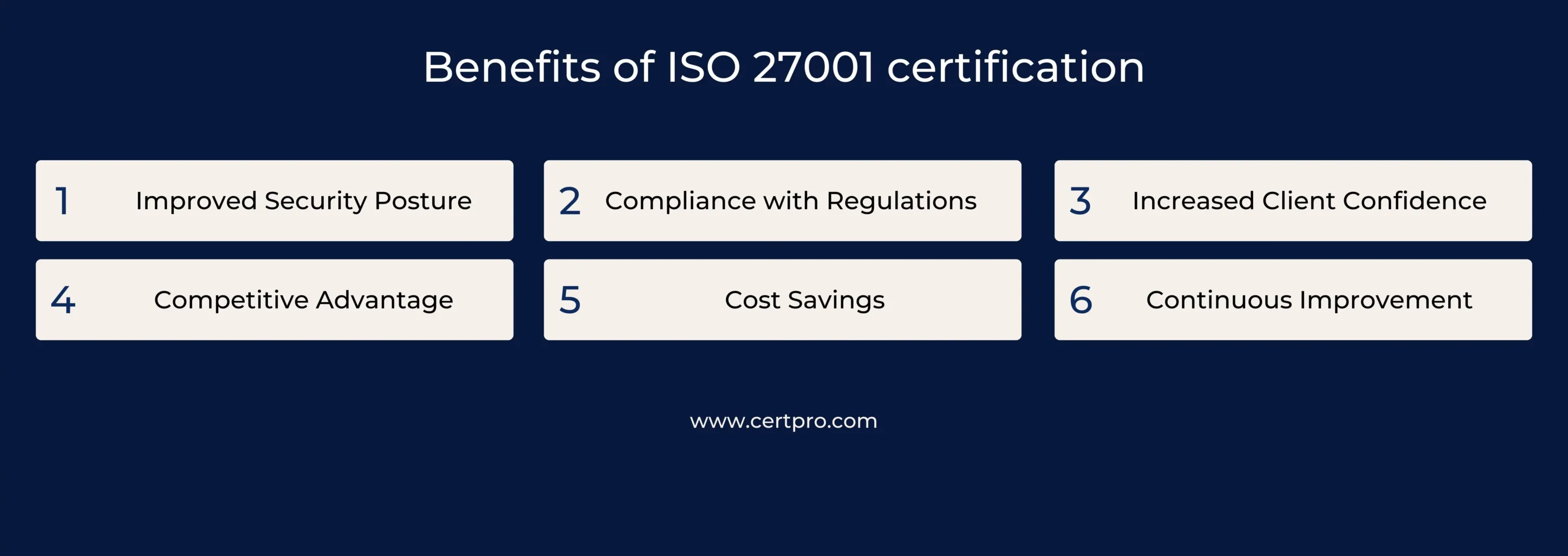
ISO 27001 Certification delivers measurable organizational benefits beyond the certificate itself. For organizations operating in Sweden’s competitive technology, financial services, healthcare, and public sector markets, the independently verified ISMS governance framework provides a foundation for risk reduction, regulatory alignment, customer trust, and operational resilience. The following represent the primary benefits realized by organizations that achieve and maintain ISO 27001 Certification in Sweden.
- ✓Independent verification of ISMS conformance that satisfies enterprise customer and public sector procurement security requirements
- ✓Structured risk management framework that systematically identifies, assesses, and treats information security risks across the organization
- ✓Documented control evidence that supports responses to security questionnaires, regulatory inquiries, and due diligence requests
- ✓Alignment with GDPR Article 32 technical and organizational measures through documented, audited information security controls
- ✓Reduced likelihood of data breaches and security incidents through systematic identification of control gaps during the ISO 27001 audit process
- ✓Demonstrated continual improvement of information security governance through mandatory management review and corrective action processes
- ✓Competitive differentiation in EU and international markets where ISO 27001 Certification is recognized as a mark of information security maturity
- ✓Foundation for alignment with complementary frameworks including NIS2 Directive requirements, DORA ICT risk management, and sector-specific security standards
The ISO 27001 ISMS framework requires organizations to take a systematic, evidence-based approach to information security rather than relying on ad hoc security measures. By conducting a structured risk assessment, selecting controls proportionate to identified risks, and operating those controls in a managed environment subject to internal audit and management review, organizations pursuing ISO 27001 compliance develop a demonstrably stronger information security posture.
The ISO 27001 certification audit — conducted by an independent, qualified audit body — provides an external perspective on control effectiveness that internal teams cannot replicate. For Swedish technology companies, fintech firms, and data-intensive organizations, this structured approach reduces the likelihood and potential impact of security incidents, data breaches, and regulatory enforcement actions.
ISO 27001 Certification is recognized across EU member states, the United States, the United Kingdom, Asia-Pacific markets, and internationally as a credible, independently verified information security standard. Swedish organizations holding ISO 27001 Certification can reference the certificate in commercial proposals, procurement responses, and security due diligence processes — without the time and resource cost of providing bespoke security evidence to each customer or partner.
For Swedish SaaS providers and cloud companies competing for contracts with regulated financial institutions, healthcare organizations, or government agencies across Europe, ISMS certification in Sweden significantly reduces friction in enterprise sales and vendor onboarding. The certification also supports investor confidence and cyber insurance underwriting, where documented ISMS governance is increasingly evaluated as a key risk factor.
- ✓Strengthening Information Security Posture
- ✓Market Access and Customer Confidence
Industries CertPro Certifies in Sweden
CertPro conducts ISO 27001 certification audits across a broad range of industries operating in Sweden. Organizations across the following sectors have pursued ISO 27001 Certification in Sweden through CertPro’s independent audit and certification process, which evaluates ISMS conformance against the full requirements of ISO/IEC 27001:2022 regardless of organizational size, technology environment, or industry vertical.
Technology, SaaS, and Cloud Service Providers
Sweden’s technology ecosystem — concentrated in Stockholm but active across Gothenburg, Malmö, Uppsala, and other urban centers — encompasses a substantial number of SaaS companies, cloud service providers, AI businesses, data analytics firms, and managed service providers. These organizations frequently process sensitive customer data, operate multi-tenant cloud environments, and serve enterprise clients who require independently verified ISMS governance.
ISO 27001 Certification is particularly relevant for Swedish technology companies because the ISO 27001 audit evaluates controls directly applicable to cloud infrastructure security, data segregation, access management, and incident response — the primary information security risk surface for cloud-native businesses. CertPro’s ISO 27001 certification audit for Sweden-based technology organizations assesses ISMS scope, technical control implementation, and Annex A control effectiveness within the specific context of cloud and software service delivery models.
Financial Services, Fintech, and Healthcare Organizations
Swedish financial institutions, fintech companies, payment service providers, and insurance organizations operate under regulatory frameworks — including DORA, the Swedish Financial Supervisory Authority (Finansinspektionen) guidance, and the EBA ICT risk guidelines — that establish information security governance expectations closely aligned with ISO 27001 ISMS requirements. ISO 27001 compliance provides these organizations with a documented, independently audited ISMS that can be referenced in regulatory reporting and supervisory examinations.
Healthcare and life sciences organizations in Sweden, including those processing health data under GDPR’s special category data provisions, similarly benefit from the structured risk management and control framework that ISO 27001 certification requires. CertPro conducts ISO 27001 certification audits for financial services and healthcare organizations across Sweden, applying audit methodology calibrated to the information security risks characteristic of these sectors.
| Industry Sector | Primary ISO 27001 Relevance | Key Swedish Regulatory Context |
|---|---|---|
| SaaS & Cloud Providers | Cloud security controls, data segregation, incident response, supplier management | GDPR, NIS2 Directive |
| Fintech & Financial Services | ICT risk management, access control, operational resilience, third-party risk | DORA, Finansinspektionen, EBA guidelines |
| Healthcare & Life Sciences | Health data protection, access management, breach notification, continuity planning | GDPR (special category), Dataskyddslagen |
| Telecommunications | Network security, service availability, incident management, data confidentiality | NIS2 Directive, EECC |
| Gaming & E-commerce | Payment data security, user account protection, fraud controls, data retention | GDPR, PCI DSS alignment |
Why Choose CertPro for ISO 27001 Audit in Sweden?
CertPro is a Licensed CPA Firm operating as an independent third-party certification body for ISO 27001 audits in Sweden. CertPro’s ISO 27001 certification audits are conducted by qualified information security auditors with technical competence across the domains addressed by ISO/IEC 27001:2022. The firm applies structured audit methodology derived from ISO 19011 principles, ensuring that each ISO 27001 certification audit in Sweden is conducted systematically, objectively, and in accordance with the evidentiary standards required for certification decisions.
CertPro’s institutional positioning as an independent audit body — not an advisory or consulting firm — ensures that the certification process maintains the independence and objectivity that gives the ISO 27001 certificate its value to customers, regulators, and procurement bodies.
Independent Audit Methodology and Certification Authority
CertPro conducts ISO 27001 certification audits — not advisory engagements or readiness assessments. This distinction is fundamental to the integrity of the certification process. As an independent certification body, CertPro evaluates organizations objectively against the requirements of ISO/IEC 27001:2022, issues findings based solely on audit evidence, and makes certification decisions grounded in conformance assessment rather than commercial relationship.
For Swedish organizations seeking ISO 27001 Certification in Sweden, CertPro’s independent audit methodology provides the credibility assurance that customers and regulators expect from a third-party certification body. The certificate issued by CertPro reflects a rigorous, evidence-based assessment of ISMS conformance — not a declaration resulting from an advisory engagement with the firm that also designed the ISMS.
Audit Competence Across Sweden’s Technology and Business Sectors
CertPro’s audit teams bring sector-specific knowledge relevant to Sweden’s technology, financial services, healthcare, telecommunications, gaming, and public sector industries. Auditors conducting the ISO 27001 audit for Sweden-based organizations understand the technical environments, regulatory contexts, and information security risk profiles characteristic of these sectors — enabling more precise and relevant assessment of ISMS design and control effectiveness.
This sector competence is particularly important for organizations operating complex cloud architectures, multi-jurisdictional data processing environments, or highly regulated service delivery models. CertPro conducts both on-site and remote ISO 27001 certification audits for organizations across Stockholm, Gothenburg, Malmö, Uppsala, and Sweden’s broader geography, adapting audit delivery format to organizational context while maintaining consistent evaluation standards.
FAQ
▶
What is ISO 27001 Certification?
▶
What is ISO 27001 Certification and who issues it in Sweden?
▶
How long does the ISO 27001 certification audit process take in Sweden?
▶
What is the difference between the Stage 1 and Stage 2 ISO 27001 audit?
▶
Does ISO 27001 certification in Sweden establish GDPR or NIS2 compliance?
▶
How often must ISO 27001 surveillance audits be conducted?
▶
What is the Statement of Applicability and why is it important?
▶
Which Swedish organizations are required to pursue ISO 27001 certification?
Get In Touch
have a question? let us get back to you.