

The General Data Protection Regulation (GDPR) is vital for today’s digital landscape. It is a cornerstone for safeguarding people’s privacy rights in the European Union (EU). Therefore, organizations dealing with EU residents’ data must follow these GDPR rules. Conducting regular GDPR audits is essential for ensuring and maintaining compliance. By doing this, companies can reduce the chances of non-compliance. It creates a suitable environment for keeping data private, as the GDPR requirements require.
Embarking on a GDPR compliance audit may initially seem overwhelming. However, procedures are crucial to ensuring your organization aligns with GDPR rules. Thus, many organizations seem overwhelmed with the details of executing a comprehensive GDPR audit. We’re here to guide you through conducting one effectively. You can confidently conduct one in your organization by following the steps in this blog.
ABOUT GDPR COMPLIANCE AUDIT
A GDPR compliance audit thoroughly reviews an organization’s data-related policies, procedures, and practices. It aims to measure the degree to which these aspects conform to the specific requirements and principles outlined in the GDPR.
First, organizations must adhere to rules for collecting, processing, storing, and transferring data. Consequently, organizations must be transparent and accountable when handling personal information. Secondly, the audit identifies weaknesses in the organization’s data management that may not meet GDPR standards or require improvement. These findings guide corrective actions and enhancements of comprehensive GDPR compliance.
GDPR AUDIT VS GDPR CERTIFICATION: WHAT IS THE DIFFERENCE
Many organizations use the terms GDPR audit and GDPR certification interchangeably, but they represent two distinct processes with different outputs, purposes, and levels of formal recognition. Understanding the difference is essential before engaging an auditor or planning your compliance program.
A GDPR audit is an internal or external assessment of how well your organization’s data protection practices align with the requirements of the General Data Protection Regulation. It identifies gaps, documents findings, and produces a report outlining areas of compliance and non-compliance. A GDPR audit can be conducted at any time — as a readiness check before a regulatory inspection, as part of an annual compliance review, or following a data breach or significant system change.
GDPR certification is a formal process under GDPR Article 42 and 43, whereby an accredited certification body evaluates an organization’s processing activities against approved certification criteria and issues a formal certificate of compliance. GDPR certification is publicly recognized, time-bound — valid for up to three years — and carries institutional credibility that an internal audit alone cannot provide.
| GDPR Audit | GDPR Certification | |
|---|---|---|
| Purpose | Assess compliance, identify gaps | Formal third-party verification of compliance |
| Conducted by | Internal team or external auditor | Accredited certification body |
| Output | Audit report with findings | Formal certificate of compliance |
| Regulatory recognition | Internal reference | Publicly recognized under GDPR Article 42 |
| Frequency | Annual or trigger-based | Valid for up to 3 years, then renewed |
| Required by GDPR | No — recommended | Optional but strongly encouraged |
For organizations that need to demonstrate GDPR compliance to enterprise clients, EU data protection authorities, or procurement teams, certification provides a level of assurance that an internal audit report cannot. CertPro conducts both — structured GDPR audit engagements and formal certification assessments — as a Licensed CPA Firm with experience across 25+ countries.
WHAT DOES A GDPR AUDITOR DO
A GDPR auditor is an independent professional or firm that evaluates an organization’s data protection practices against the requirements of the General Data Protection Regulation. Understanding the role of a GDPR auditor helps organizations know what to expect during an engagement and how to prepare their teams effectively.
Core Responsibilities of a GDPR Auditor: A GDPR auditor reviews the organization’s data processing activities, privacy policies, consent mechanisms, data subject rights procedures, vendor contracts, security controls, and breach notification processes. They conduct structured interviews with key personnel — including the Data Protection Officer (DPO), IT team, legal counsel, and operational managers — to assess how documented policies translate into actual practice.
The auditor maps data flows to verify that personal data is collected, processed, stored, and transferred in accordance with GDPR principles — lawfulness, fairness, transparency, purpose limitation, data minimization, accuracy, storage limitation, integrity, and confidentiality. Any deviations from these principles are documented as findings, categorized by severity, and included in the formal audit report.
Internal GDPR Auditor vs External GDPR Auditor: An internal GDPR auditor is an employee — typically within the compliance, legal, or data protection function — who conducts periodic self-assessments. Internal audits are valuable for identifying gaps early and maintaining ongoing readiness, but they lack independence and are not recognized by supervisory authorities as third-party verification.
An external GDPR auditor is an independent firm or individual engaged specifically to conduct an objective assessment. External audits carry more weight with regulators, enterprise clients, and procurement teams because they demonstrate that the organization’s compliance has been verified by a party with no conflict of interest. GDPR compliance assessment conducted by an accredited external auditor is the standard expected during regulatory investigations and enterprise due diligence processes.
Qualifications of a GDPR Auditor: A qualified GDPR auditor should have formal training in data protection law and GDPR requirements, experience conducting structured compliance assessments, familiarity with the applicable supervisory authority guidance — ICO in the UK, CNIL in France, BaFin context in Germany, Dutch AP in the Netherlands — and ideally holds credentials such as CIPP/E, CIPM, or ISO 27701 lead auditor certification.
CertPro’s GDPR audit engagements are conducted under the oversight of a Licensed CPA Firm, with auditors holding ISO 27001 Certification lead auditor credentials and cross-framework experience across SOC 2, HIPAA, GDPR, and ISO 27701. Every engagement is independently quality-reviewed before report issuance — the same standard applied across all CertPro audit programs.
THE IMPORTANCE OF A GDPR AUDIT
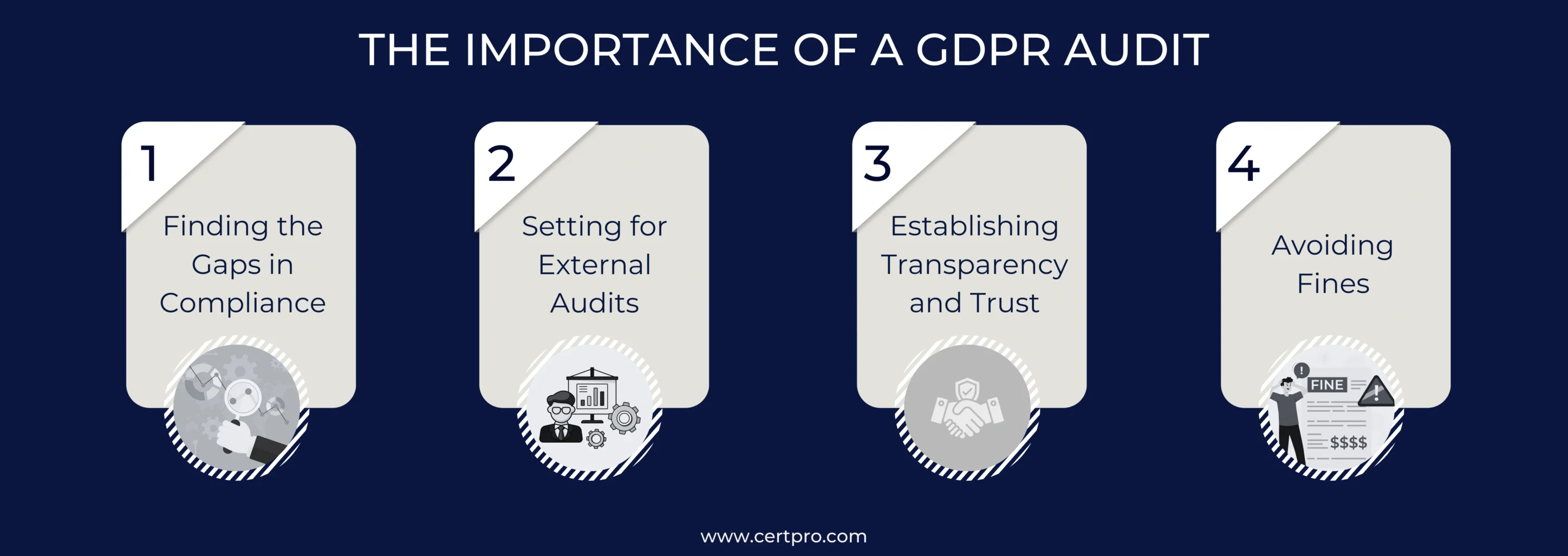
A GDPR Compliance Audit holds significant importance for several reasons:
Finding the Gaps in Compliance: Organizations can objectively review their data policies and processes through audits. This helps find areas that need improvement. Accordingly, this proactive approach allows for a timely resolution.
Setting for External Audits: Regulatory bodies like the ICO may conduct audits to ensure GDPR compliance. Hence, internal audits help organizations remain prepared for external reviews. This ensures compliance and the ability to show adherence to regulations.
Establishing Transparency and Trust: Demonstrating compliance through audits enhances trust and confidence among customers and stakeholders. In addition, it shows dedication to protecting people’s data rights. Also, it promotes transparency and accountability in data handling practices.
Avoiding Fines: Non-compliance with GDPR can lead to hefty fines. Consequently, organizations can minimize the risk of penalties by identifying and rectifying compliance issues through audits. Therefore, it safeguards the reputation and financial stability of the organization.
GDPR ENFORCEMENT AND FINES IN 2026
Understanding the regulatory enforcement landscape is essential context for any GDPR audit. Fines under GDPR are not theoretical — supervisory authorities across the EU and UK have issued billions of euros in penalties since the regulation became enforceable in May 2018, and enforcement activity has accelerated significantly in recent years.
GDPR Fine Structure
GDPR Article 83 establishes a two-tier fine structure. Tier 1 fines — for less severe infringements such as failure to maintain records of processing activities or failure to notify a breach — can reach up to €10 million or 2% of global annual turnover, whichever is higher. Tier 2 fines — for more serious violations including unlawful processing of personal data, violation of data subject rights, or international data transfer failures — can reach up to €20 million or 4% of global annual turnover.
| Supervisory Authority | Country | Known for |
|---|---|---|
| Irish DPC | Ireland | Regulates EU headquarters of major US tech companies |
| CNIL | France | Active enforcement on cookie consent and tracking |
| Dutch AP | Netherlands | Focus on AI, healthcare, and public sector data |
| ICO | UK | UK GDPR enforcement — post-Brexit independent regulator |
| BaFin / DSK | Germany | Federal and state-level enforcement across sectors |
| Italian Garante | Italy | Active on biometric data and facial recognition |
What Triggers a GDPR Audit by a Supervisory Authority: Regulatory GDPR audits are typically triggered by one of four events — a data breach notification under Article 33, a complaint filed by a data subject, a referral from another supervisory authority, or a routine sector-wide inspection. Organizations that have experienced a data breach and failed to notify within the 72-hour window face significantly elevated fine risk, as breach notification failures are among the most consistently penalized violations across all EU supervisory authorities.
2025-2026 Enforcement Trends: Enforcement focus has shifted significantly toward AI-driven data processing, cookie consent mechanisms, cross-border data transfers under post-Schrems II frameworks, and the processing of special category data including health and biometric records. Organizations using AI tools that process personal data are increasingly scrutinized — the intersection of GDPR and the EU AI Act has created new audit obligations that did not exist at the time GDPR came into force.
Conducting a regular GDPR compliance assessment is the most effective way to stay ahead of regulatory risk — identifying and closing gaps before a supervisory authority does it for you. CertPro’s GDPR audit program covers the full scope of GDPR obligations including Article 30 records, consent management, DPIA requirements, data subject rights procedures, and cross-border transfer mechanisms.
GDPR AUDIT STEPS FOR YOUR BUSINESS
Look at the essential steps of conducting a GDPR audit for your business.
1. Create an Audit Plan: In the initial phase, crafting a detailed plan that aligns with GDPR requirements is crucial. While ISO templates can help structure the process. However, it may not directly cover GDPR specifics. The plan should assess EU resident data for effective compliance. Consequently, assigning responsibility for data handling and implementing authentication procedures is necessary. Again, updating data repositories post-removal is needed. Therefore, the audit plan must address EU residents’ data exposure, encryption, and notification. Besides, documenting cases with a forensic audit trail is recommended. Thus, organizations should consider some aspects when developing a GDPR audit plan. It covers the data lifecycle, classification, risk management, security, and supply chain. This assertive approach ensures ongoing compliance and minimizes data handling risks.
2. Identify Compliance Gaps and Report the Findings: It’s essential to evaluate your GDPR compliance program. It involves checking records, processing access requests, and using technical security measures. Also, follow privacy rules and data transfer methods. Accordingly, the GDPR’s impact extends across various departments within an organization. During the audit’s discovery phase, interviews and policy reviews will be conducted. Thus, it includes those managing governance, operations, or technical controls. This phase aims to gauge the organization’s alignment with GDPR rules. Hence, discovery sessions are crucial to assessing how well the organization meets GDPR requirements. It includes data processing, privacy principles, security controls, and data transfer methods.
During this phase, the auditors evaluate if the organization follows GDPR rules. This includes access requests, privacy guidelines, tech security controls, and continuous compliance monitoring. Following the discovery phase, auditors outline existing procedures and identify differences. They create a report showing how well the organization follows GDPR rules. The report may offer detailed insights for necessary adjustments. Then, provide a concise assessment, categorizing findings as “aligned” or “not aligned. It is vital to take corrective action for issues classified as “not aligned.”
3. Prioritize and Resolve the Gaps: Subsequently, the audit team must prioritize non-compliant areas based on risk levels. After that, emphasizing a risk-based approach is essential. It considers regulators’ focus on breaches and handling requests from individuals to access their data. Therefore, factors like likelihood, severity of non-compliance, and how it affects the business. Then, begin by addressing high-risk areas identified in the discovery phase.
Addressing gaps usually requires a partnership among various individuals or teams. Therefore, assign tasks to appropriate remediation owners and set realistic deadlines. Certain remediation efforts, such as technical updates or training staff on managing data, require extra time and resources. Similarly, allocate budgets and resources accordingly to facilitate effective remediation.
4. Evaluate the Remedial Actions: It takes significant time and resources to identify and rectify compliance gaps. After addressing compliance gaps, the organization verifies whether it follows GDPR rules. This means testing controls well to ensure gaps are closed and resolve any new issues that may arise. Therefore, highlighting the significance of auditing to confirm compliance post-gap closure is crucial.
Furthermore, this process is ongoing. Regular audits are vital to ensure the efficiency of privacy and compliance programs. Consistent monitoring and enforcement are necessary to evaluate the effectiveness of GDPR requirements. Accountability remains a core principle of the GDPR.
UNDERSTAND THE GDPR AUDIT CHECKLIST
Governance and Accountability: In conducting a GDPR audit, management and accountability are paramount. This involves clearly defining the organization’s data protection roles, responsibilities, and reporting lines. Also, robust policies, procedures, and training are needed to follow GDPR rules. Consequently, keeping thorough records of processing activities is essential for transparency and accountability. Therefore, implementing data protection from the start ensures privacy at every processing stage. Conducting Data Protection Impact Assessments (DPIAs) finds and resolves risks to data privacy. Finally, having well-defined data breach reporting procedures is vital. It helps to promptly address and notify authorities of any security incidents.
Legal Basis for Processing: A GDPR audit involves documenting the legal basis for processing and using valid consent procedures. It also includes conducting legitimate interests and reviewing contracts with vendors. This includes identifying legal justifications for data processing, managing consent effectively, assessing legitimate interests, and verifying third-party compliance. These measures uphold GDPR requirements and safeguard individuals’ rights and data privacy.
Subject Rights: In a GDPR audit, procedures for handling data subject rights requests are critical. Therefore, they are involved in establishing efficient ways to handle Data Subject Access Requests (DSARs). This ensures people can easily use their rights to access, erase, and add objects to data. Specifically, implementing transparent and streamlined procedures for responding to DSARs is very important. Moreover, it deals with erasure requests. It also helps with objections, following GDPR rules, and making data processing clear.
Data Transfers and Sharing: Due diligence on vendors and third-party partners is essential in GDPR audits. Therefore, it means setting up detailed procedures to check how to handle data. This ensures the organization is following GDPR rules. Additionally, establishing data-sharing agreements with third parties helps to regulate data transfers. Consequently, legal tools like standard contractual clauses help ensure compliance with GDPR and safeguard data privacy across international borders.
Data Retention and Disposal: In a GDPR audit, it’s crucial to assess data handling practices. This includes implementing measures for data minimization, which ensures only the necessary data is collected and processed. To follow GDPR rules, it’s vital to document when data is kept and deleted. Secure methods must be used to prevent unauthorized access or breaches. When data is no longer needed, these methods minimize the risks of data breaches.
Data Security: During a GDPR audit, evaluating organizational and technical security controls is crucial. This means using encryption to keep data safe, and physical security measures should be used to restrict access. Establishing a cyber threat management program and incident response planning helps mitigate risks. Also, ensuring staff get security training and checks helps protect data better. This follows GDPR rules and strengthens the organization against possible threats.
Monitoring and Logging: In a GDPR audit, conducting data inventories to map information flows is essential. This ensures a clear understanding of data processing activities. Maintaining detailed data processing records, as GDPR Article 30 requires, shows compliance. Regularly checking and monitoring compliance helps follow GDPR rules. It helps find and fix any problems or breaches quickly.
UNDERSTAND THE GDPR AUDIT CHECKLIST
One of the most commonly asked questions about GDPR compliance is how frequently organizations should conduct formal audits. The regulation itself does not prescribe a specific audit frequency, but supervisory authority guidance and established compliance practice provide a clear framework.
Annual Audit — Baseline Recommendation: The baseline recommendation across all major supervisory authorities — including the ICO, CNIL, and Dutch AP — is a comprehensive GDPR audit at least once per year. An annual audit ensures that the organization’s data protection practices remain aligned with the current version of the regulation, reflect any changes in business operations or data processing activities, and address any findings from the previous audit cycle. Annual audits also provide the documentation trail that demonstrates ongoing accountability — a core principle of GDPR under Article 5(2).
Trigger-Based Audits — When to Audit Outside the Annual Cycle: In addition to the annual audit, certain events should trigger an immediate or expedited GDPR review regardless of when the last audit was conducted:
- Data breach or security incident — any incident involving personal data requires an immediate assessment of what data was affected, who was impacted, and whether notification obligations under Articles 33 and 34 are triggered. Maintaining accurate audit trails is critical at this stage — regulators will request them during investigation.
- New system or technology deployment — any new system that collects, processes, or stores personal data requires a Data Protection Impact Assessment (DPIA) under Article 35 if the processing is likely to result in high risk to individuals.
- New vendor or third-party processor — engaging a new data processor requires review of Article 28 contractual obligations and due diligence on the processor’s security and compliance posture.
- Regulatory or legal change — changes to applicable law, new supervisory authority guidance, or court decisions affecting data transfer mechanisms require an immediate review of affected processing activities.
- Business change — mergers, acquisitions, market expansion into new geographies, or changes to core business processes that involve personal data all require a compliance review.
Continuous Monitoring vs Periodic Audits: Annual and trigger-based audits are the structured checkpoints in your GDPR compliance program, but they should be supported by continuous monitoring throughout the year. Continuous monitoring includes maintaining up-to-date audit evidence records, reviewing access logs regularly, tracking data subject rights requests and response timelines, monitoring vendor compliance, and staying current with supervisory authority guidance and enforcement decisions.
Organizations that treat GDPR compliance as a year-round operational discipline — not a once-a-year exercise — consistently perform better during regulatory audits and face significantly lower fine risk when incidents do occur. CertPro’s GDPR compliance program supports organizations through both structured annual assessments and ongoing compliance advisory — ensuring you remain audit-ready at all times, not just in the weeks before a regulatory inspection.
SECURE GDPR AUDIT WITH CERTPRO’S EXPERT HELP
Conducting a GDPR audit is crucial nowadays to keep client’s data safe. GDPR rules protect individuals’ data and ensure companies follow privacy laws. Thus, audits recheck the company’s compliance with GDPR. Therefore, it helps avoid fines and builds trust with customers. Regular audits are a way to keep improving and show the company cares about data privacy. It’s not just about following rules but also about doing the right thing to maintain data privacy.
In short, doing GDPR audits is crucial for companies to stay legal, reduce risks, and keep data safe. CertPro is a recognized organization offering GDPR consulting services. The experts can help you understand the areas of concern. Moreover, CertPro provides cost-effective services that guarantee your data security. If you need more information about the GDPR audit and checklist, please contact CertPro.
FAQ
Are there any tools to assist in conducting a GDPR audit effectively?
Yes, there are different tools to help with GDPR rules, like software. Software streamlines audit processes and data assessment. Also, it makes reports, handles requests from people about their data, tracks remediation activities, and keeps records. Some examples include Data Protection Impact Assessment (DPIA) tools, data mapping software, and compliance management platforms.
How often should I check if my business follows GDPR rules?
How often you check depends on various factors, such as the size of your organization, the nature of data processing activities, and changes in regulatory requirements. However, it’s usually good to check every year to keep following the rules.
What happens if you don't follow GDPR rules after an audit?
If you cannot maintain the standard operation of GDPR compliance, your compliance will be discontinued and may increase the risk of data breaches and related penalties.
What are the 4 key components of GDPR?
The four main components of GDPR are the lawful processing of data, purpose limitation, data minimization, and retention. These components secure the data and eliminate risk.
How can CertPro help in your GDPR audit?
CertPro offers expert, customized guidance and cost-effective services for GDPR compliance. It assists your business in meeting legal standards and data security requirements. You can contact CertPro anytime for information related to GDPR compliance. We’re available 24/7 to help you.

About the Author
SUBBAIAH KU
Subbaiah Ku is the Regional Director for CertPro in Oman, bringing a wealth of expertise in process and system auditing. As a seasoned lead assessor, Subbaiah is dedicated to ensuring the highest standards in compliance and security. His unique blend of technical acumen, rooted in Mechanical Engineering, is complemented by a diverse range of certifications and extensive training.
GDPR BASICS FOR SAAS: REQUIREMENTS, PRINCIPLES & COMPLIANCE GUIDE

DATA MAPPING FOR GDPR: BUILDING A COMPLIANCE-READY INVENTORY
Have you ever tried to answer a simple question like “Where’s our customer data stored?” Most probably, you would have found yourself hopping across five different tools and six spreadsheets. Despite all the research work, you might still get a negative signal from...
10-STEP GDPR CHECKLIST: A COMPLETE GUIDE
In the current global economy, businesses are heavily dependent on customer data. This helps them in enhancing business operations and providing customized services. However, this dependency also comes with the responsibility of protecting the data. One of the most...